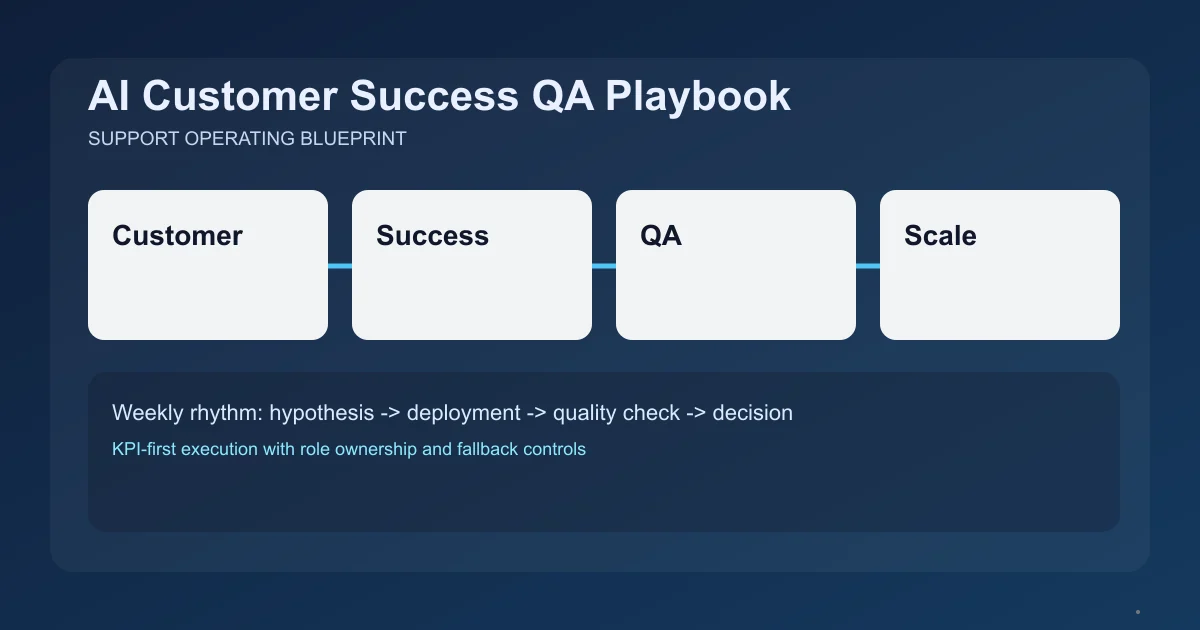
AI Customer Success QA Playbook is most useful when applied to one real team process, not as a broad transformation project. Use this guide as a practical working document: pick one process, instrument it, and improve it week by week.
Key Takeaways
- Treat implementation as an operating system, not a one-off project.
- Make metric reviews a fixed weekly ritual.
- Prioritize changes by expected lift on customer health and renewal confidence.
1. Define scope before tools
Treat v1 as an evidence sprint. Pick one use case where outcomes can be verified weekly instead of launching broad, hard-to-measure automation.
2. Design the end-to-end workflow
Operational quality depends on explicit transitions. Document where humans approve, where automation runs, and where exceptions are routed.
- Input and context collection
- AI generation or decision stage
- Human review and approval
- Action execution and logging
3. Instrument metrics from day one
Use one KPI scorecard with leading and lagging indicators. This makes prioritization objective and keeps iteration focused on customer health and renewal confidence.
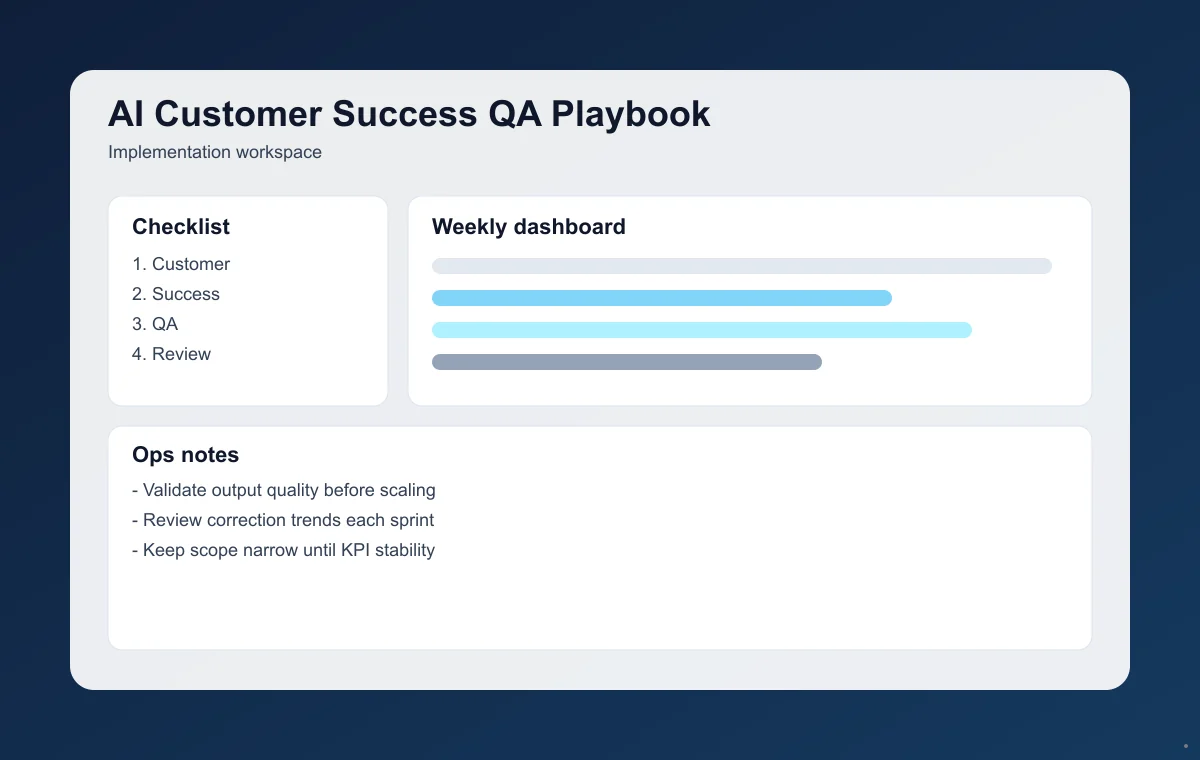
4. Run a weekly execution loop
- Select highest-leverage bottleneck from last week's data.
- Deploy one focused improvement with monitoring.
- Audit edge cases and correction workload.
- Feed learnings into next sprint planning and documentation.
5. Avoid common implementation mistakes
- Launching without KPI targets and review rhythm
- No QA checkpoint before automated actions
- Treating one week of gains as proof of stability
- Ignoring user correction patterns in prioritization
Final takeaway
AI Customer Success QA Playbook drives results when teams treat it as a product operating system: focused scope, clear metrics, and disciplined weekly iteration.
For deeper implementation, continue with AI Agent Evaluation Framework and AI Prompt Engineering for Products. Then use the full article library to plan your next execution sprint.
Frequently Asked Questions
What team setup works best for AI Customer Success QA Playbook?
Use a small cross-functional pod: product owner, operator, and technical implementer with one shared KPI target.
How do we handle edge cases safely?
Define fallback behavior and human escalation before rollout, then monitor exception rates in every review cycle.
How soon can we expect measurable impact?
Most teams see directional movement within 1-2 weeks when instrumentation is live and changes are tied to customer health and renewal confidence.