First customers should teach you positioning, onboarding, and pricing, not just fill pipeline numbers. This playbook focuses on quality signals that compound into repeatable growth.
Key Takeaways
- Package one narrow offer with one measurable result.
- Prioritize high-signal prospects over large lead lists.
- Treat every early call as both sales and product research.
1. Package One Founder Offer
Build a short founder-led offer: one workflow outcome, four-week pilot, one KPI dashboard, and clear next-step pricing. Remove feature-heavy language and model details from the headline.
- Who: one target role in one company type
- What: one painful workflow you improve
- How much: one measurable expected gain
- Timeline: short pilot window with weekly checkpoints
2. Build a Structured 100-Account List
Create a targeted account list where your workflow pain is likely visible. Score each account by urgency, budget ownership, and process complexity.
- Tier A: ideal fit, urgent pain, clear buyer path
- Tier B: good fit, moderate urgency, partial buyer clarity
- Tier C: weak pain evidence, low priority
Start with Tier A only. Early-stage founder time should be concentrated where conversion odds are highest.
3. Run Personalized Outreach in Tight Batches
Use outcome-led messaging and send in batches of 20-30 accounts so you can iterate fast.
Message structure:
- One line showing role and workflow relevance
- One measurable promise tied to their operational reality
- One simple CTA for a 20-minute discovery call
Avoid generic outreach automation in this phase. Quality signal matters more than message volume.
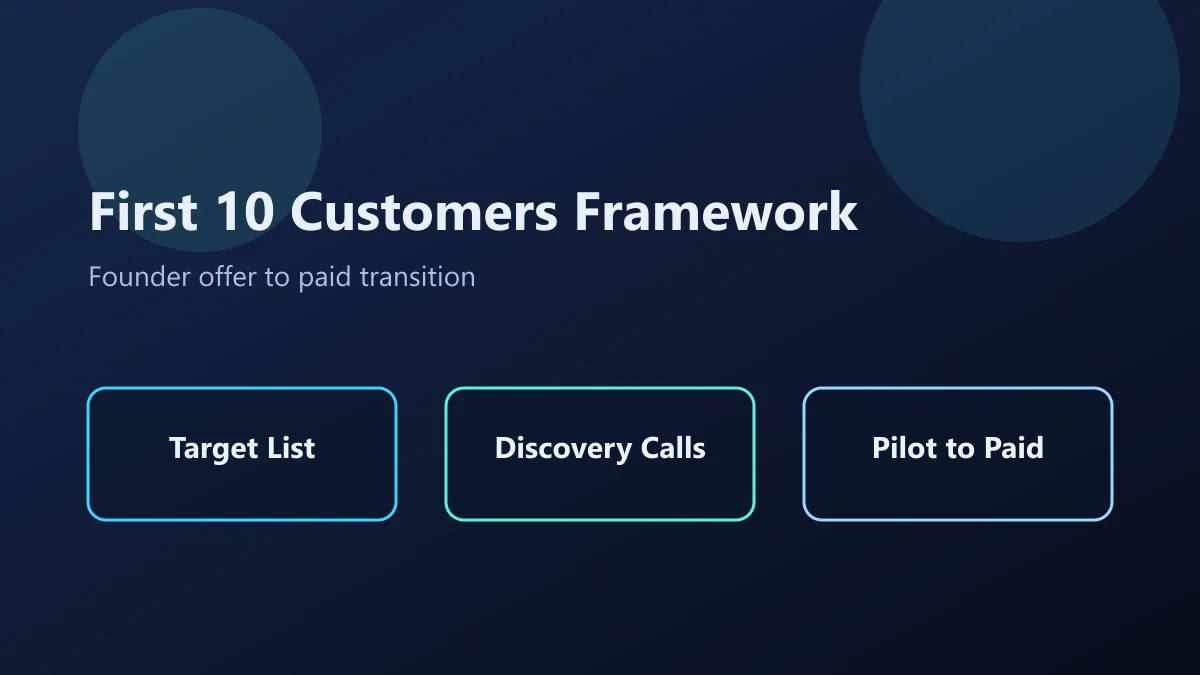
4. Run Discovery Calls With a Qualification Framework
Each call should capture these five data points:
- Pain frequency and severity
- Current workaround and its cost
- Decision owner and budget authority
- Risk and compliance constraints
- What would make a pilot "successful" internally
Log objections in a shared sheet and update outreach copy weekly. Objections are positioning assets.
Conversion Scripts That Improve Call-to-Pilot Rate
Use simple language that frames risk clearly:
- "Let us run this on one workflow for four weeks and measure one KPI together."
- "If the KPI is not met, we stop. If it is met, we roll into your paid plan with no scope surprises."
- "We will send a one-page pilot scorecard every Friday so your team sees progress."
This positioning lowers buyer uncertainty and shortens internal approval cycles.
5. Convert Pilots to Paid With Predefined Exit Criteria
Define commercial transition before pilot kickoff. Do not wait until the final week to discuss pricing.
- Set baseline and target KPI on day one
- Align on post-pilot scope and support model in week one
- Review KPI trend and decision path in week three
- Run paid handoff meeting with buyer and operator in week four
This process prevents ambiguous pilot endings and improves close rates.
6. Use a First-10-Customers Scoreboard
Track quality metrics, not just meetings booked:
- Qualified reply rate by segment
- Discovery-to-pilot conversion
- Pilot activation rate
- Pilot-to-paid conversion rate
- Time from first call to paid signature
If top-of-funnel responses rise but pilot activation drops, your messaging is overpromising. Fix positioning before scaling.
Final takeaway
Your first 10 customers should produce a reliable commercialization pattern: repeatable offer, repeatable objections, repeatable conversion path. Build that pattern before you chase volume.
After first wins, scale acquisition with the distribution playbook and improve monetization quality with the pilot-to-paid conversion guide.
Frequently Asked Questions
Should AI founders use paid ads for first customers?
Usually no. For the first 10 customers, direct outreach, warm intros, and targeted communities produce better signal and lower acquisition cost.
How many outreach messages are needed for first traction?
A focused campaign of 80-150 personalized messages can be enough if your segment and value proposition are specific.
What should the first customer offer include?
Keep the offer simple: one workflow, one measurable outcome, one short pilot timeline, and a clear success metric.