Most AI startups do not fail because of model quality. They fail because they launch too early with unclear value, weak trust controls, or no repeat usage loop. This checklist gives you a practical pre-scale quality gate.
Key Takeaways
- Validate one workflow deeply before adding features.
- Track user outcomes, not just prompt success.
- Use simple scoring to decide whether to build, refine, or relaunch.
How To Use This Checklist
- Score each item as Green, Yellow, or Red using pilot evidence.
- Fix Reds first, then highest-impact Yellows that block conversion or retention.
- Run the checklist weekly during your first 6-8 weeks after launch.
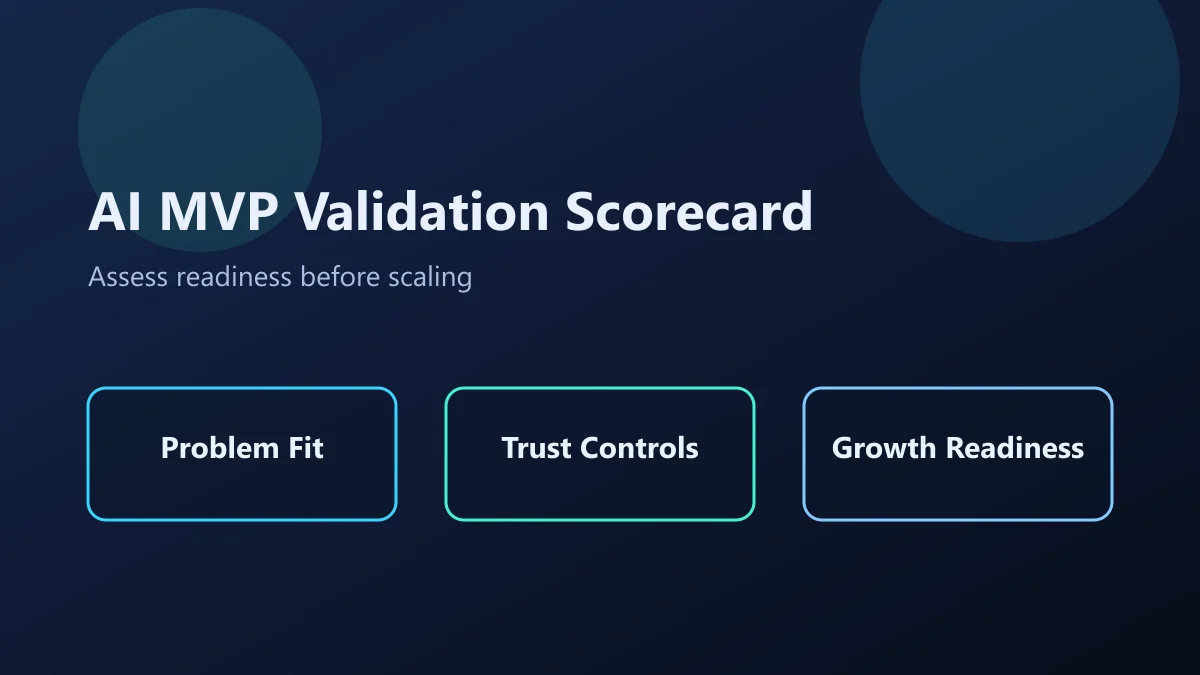
1. Problem Fit Checklist
Your MVP should solve a pain users already feel today, not a hypothetical future need.
- At least 10 interviews were completed in one target segment.
- At least five interviewees described the same workflow pain in different language.
- The pain occurs multiple times per week and has clear cost.
- Users already use a manual workaround that is slow, expensive, or error-prone.
- You can describe the problem in one sentence without product jargon.
If this section is weak, pause build expansion and return to segment-level discovery. Use the problem-fit guide to reset signal quality.
2. Value Fit Checklist
Users need a clear, measurable promise they can verify quickly.
- Your primary value promise includes a measurable number.
- First meaningful value appears in under 10 minutes for a new user.
- Users can explain what the product improved in plain language.
- Your onboarding flow reinforces one core use case, not multiple branches.
- Product copy uses outcomes, not abstract words like "smart" or "advanced."
When value language is vague, acquisition quality drops and pricing resistance rises. Align your offer with the first customers playbook before scaling outbound.
3. Trust Fit Checklist
AI output without user control does not survive real workflows.
- Users can edit, approve, or reject output with low effort.
- Risky outputs include context or assumptions for quick verification.
- Failures are recoverable with fallback steps and clear messaging.
- Critical actions have logs, history, or version visibility.
- Your team tracks correction reasons, not just acceptance rates.
Trust controls are retention controls. Most early churn in AI products happens when users feel they cannot safely rely on output quality.
4. Growth and Monetization Fit Checklist
A validated MVP should show early signs of repeat usage and paid intent.
- Activation is defined as a user outcome, not account creation.
- At least 30% of activated pilot users return weekly.
- You have one segment with explicit willingness to pay.
- Pricing plans map to user outcomes and operational value.
- You know the top three reasons users abandon the workflow.
If paid intent is weak, revisit positioning and commercial structure using the pricing mistakes guide.
5. Scoring Model for Fast Decisions
Use a simple weighted score to avoid opinion-heavy debates.
- Problem Fit: 30%
- Value Fit: 30%
- Trust Fit: 25%
- Growth Fit: 15%
Decision rule:
- 80-100: Expand distribution and paid conversion efforts.
- 60-79: Keep pilots running and fix top blockers before scale.
- Below 60: Tighten scope and run another two-week learning sprint.
6. What To Do After Scoring
Validation is only useful when it changes execution priorities.
- If Problem Fit is low, prioritize interviews and segment clarity.
- If Value Fit is low, rewrite onboarding and simplify first workflow.
- If Trust Fit is low, ship editability and fallback controls first.
- If Growth Fit is low, refine packaging and paid transition criteria.
After checklist stabilization, use the distribution playbook to scale qualified user acquisition without lowering conversion quality.
Final takeaway
An AI MVP is ready when users can get value fast, trust the output, and repeat the workflow without heavy support. Validate that system first. Scale second.
Frequently Asked Questions
How many checklist items should be green before launching an AI MVP?
As a practical rule, aim for at least 70% green across problem, value, trust, and growth categories before broad rollout.
What is the most important early AI MVP metric?
Median time-to-value is usually the best first metric because it reflects onboarding clarity, UX quality, and real usefulness.
Should founders optimize model quality before user workflow quality?
No. Workflow reliability and user control should come first, then model optimization based on real usage data.