Early AI products fail technically when teams overbuild infrastructure before validating usage. The right MVP stack is not the most advanced stack. It is the one that supports fast learning with predictable reliability.
Key Takeaways
- Start from workflow requirements, not favorite tools.
- Add reliability and observability before advanced optimization.
- Track time-to-value and correction rate from day one.
1. Design One Complete Workflow First
Define a full vertical slice: input capture, generation, user review, and output delivery. Avoid disconnected prototypes that never prove production viability.
- One role
- One repeatable task
- One output format
- One quality baseline
2. Build a Minimal Production Stack
Your MVP stack should be simple enough for fast iteration and stable enough for paid pilots.
- Frontend: one focused UI flow with clear state and error visibility
- Backend: API layer for prompt orchestration and provider abstraction
- Storage: user context, outputs, edits, and quality events
- Queueing: async tasks for long-running generation workloads
- Analytics: event pipeline for activation and trust metrics
Choose boring, maintainable technology in v1. Complexity should be justified by usage, not preference.
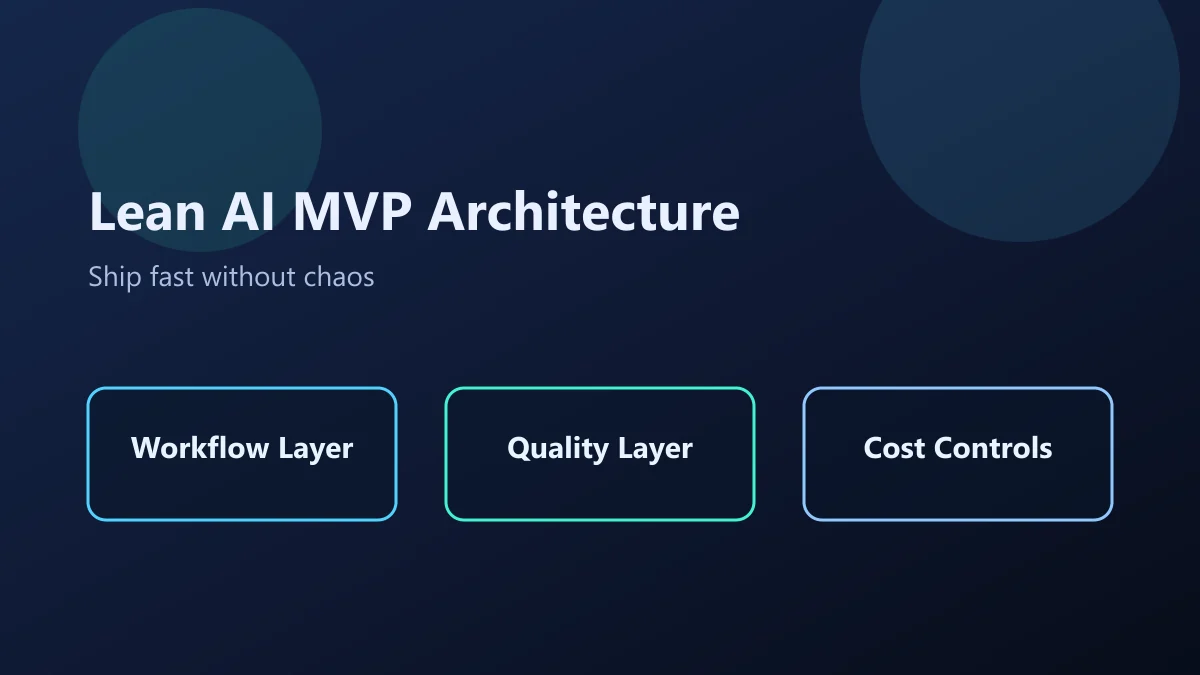
3. Add a Quality and Trust Layer Early
Model output quality fluctuates. Product trust should not.
- Editable outputs and quick correction UX
- Prompt/version tracking for reproducibility
- Fallback path for failed or low-confidence responses
- Human review checkpoints for sensitive actions
Reliability controls are conversion controls in early B2B AI products.
Engineering Operating Model for MVP Speed
Use a weekly cycle that connects product and technical quality:
- Review output corrections and failed runs.
- Prioritize one quality fix and one UX clarity fix.
- Ship and measure impact on activation and retention.
This keeps engineering priorities tied to user outcomes instead of internal architecture debates.
4. Put Cost Controls Into Product Logic
Do not treat cost management as a finance-only topic. It should be coded into request flow and plan design.
- Cache deterministic transformations where possible
- Use request budgets by plan and workflow type
- Route simpler tasks to cheaper model classes
- Track cost per successful user outcome, not just cost per call
5. Ship Basic Security and Compliance Guardrails
Enterprise pilots require trust in data handling, even in early stage.
- Role-based access controls for workspace actions
- Audit logs for critical workflow events
- Data retention rules and deletion pathways
- Clear boundaries on model training and data usage
Simple and transparent controls often outperform heavy policy documents in early sales cycles.
6. Define Scale Readiness Triggers
Scale architecture only when your data supports it. Good triggers include:
- Sustained weekly return usage over multiple customer cohorts
- Stable output acceptance and correction-rate trends
- Predictable lead flow and pilot-to-paid conversion
- Known bottlenecks in latency or concurrency under load
Final takeaway
The best AI MVP stack is the smallest system that delivers consistent user outcomes with clear trust controls. Optimize for learning speed, not architectural perfection.
After technical baseline is stable, align commercialization with the pilot-to-paid guide and acquisition with the distribution playbook.
Frequently Asked Questions
How much infrastructure is enough for an AI MVP?
Enough to support one workflow reliably with logging, fallback handling, and basic quality checks. Avoid premature scale architecture.
Should founders build custom model pipelines in v1?
Usually no. Start with managed APIs and optimize only after usage patterns and unit economics are clear.
What technical metric matters most in early AI products?
Median time-to-value is often the strongest early indicator because it captures speed, usability, and product trust.