Founders lose months by validating solutions before validating pain. This framework helps you gather enough evidence to decide whether to build now, refine the segment, or stop early.
Key Takeaways
- Pick one role and one repeated workflow pain.
- Score interview patterns before discussing solution design.
- Only build after you can explain value in one sentence.
1. Pick One Segment With Urgent Pain
Choose a narrow audience with shared constraints, such as agency account managers, support leads, or claims analysts. Broad categories like "SMBs" dilute problem signal quality.
Write a one-line segment definition before interviews. Include role, context, and task type to avoid drift.
2. Run 10-15 Structured Interviews
Ask for recent examples, not abstract opinions. Your goal is behavioral evidence.
- When did this issue happen last?
- How often does it happen?
- How much time or money does it cost?
- What workaround is used now?
- Who owns the budget to fix it?
If users cannot name recent examples, urgency is likely low.
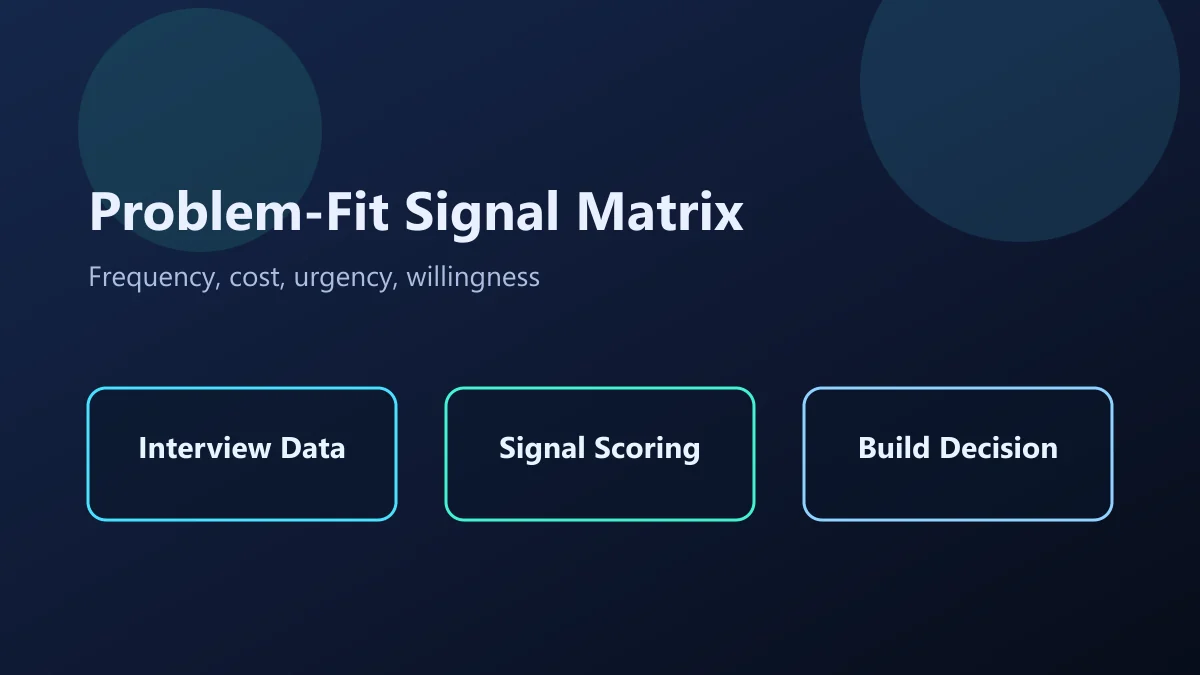
3. Score Signals Using a Simple Matrix
Rate each interview on a 1-5 scale across four dimensions:
- Frequency of pain
- Operational cost
- Urgency to solve
- Willingness to change workflow
If one pain pattern repeatedly scores high, you have enough direction for a narrow MVP.
Interview Quality Checkpoints
Review these after each interview block:
- Did we learn new pain evidence or repeat existing patterns?
- Are we hearing role-specific language or generic complaints?
- Do we know who signs budget and what success means to them?
These checkpoints prevent false-positive validation.
4. Draft One Measurable Value Offer
Convert pain into value language users can verify. Example: "Cut manual claim triage time by 35% for insurance support teams."
If users cannot estimate whether the result happened, the offer is too vague.
5. Make a Build, Refine, or Stop Decision
Use one fast decision rule:
- Build: repeated pain + high urgency + clear ROI statement
- Refine: repeated pain but weak urgency or unclear buyer path
- Stop: inconsistent pain patterns across interviews
6. Practical 14-Day Problem-Fit Timeline
- Days 1-3: segment hypothesis, interview list, script prep
- Days 4-9: run interviews and score pain signals daily
- Days 10-12: synthesize pattern map and draft value statement
- Days 13-14: decide build/refine/stop and set next sprint goals
Final takeaway
Problem-fit is the highest-leverage startup decision. Validate one painful workflow deeply, then build a thin MVP around that signal. This reduces wasted engineering and improves early commercialization speed.
When you choose build, move to the AI MVP validation checklist and the MVP tech stack playbook.
Frequently Asked Questions
How long should problem discovery take for an AI startup?
For an early-stage team, 10-14 focused days is enough to validate one segment, one painful job, and one measurable problem statement.
What is a strong problem signal before building?
A strong signal is when multiple people in the same role report the same painful workflow and already spend time or money solving it manually.
Should founders prototype before finishing interviews?
You can prototype after you hear repeated pain, but avoid full MVP build until your problem statement and buyer segment are stable.