Most AI products lose users after onboarding because value is inconsistent or hard to trust. This guide focuses on practical retention mechanics you can ship weekly.
Key Takeaways
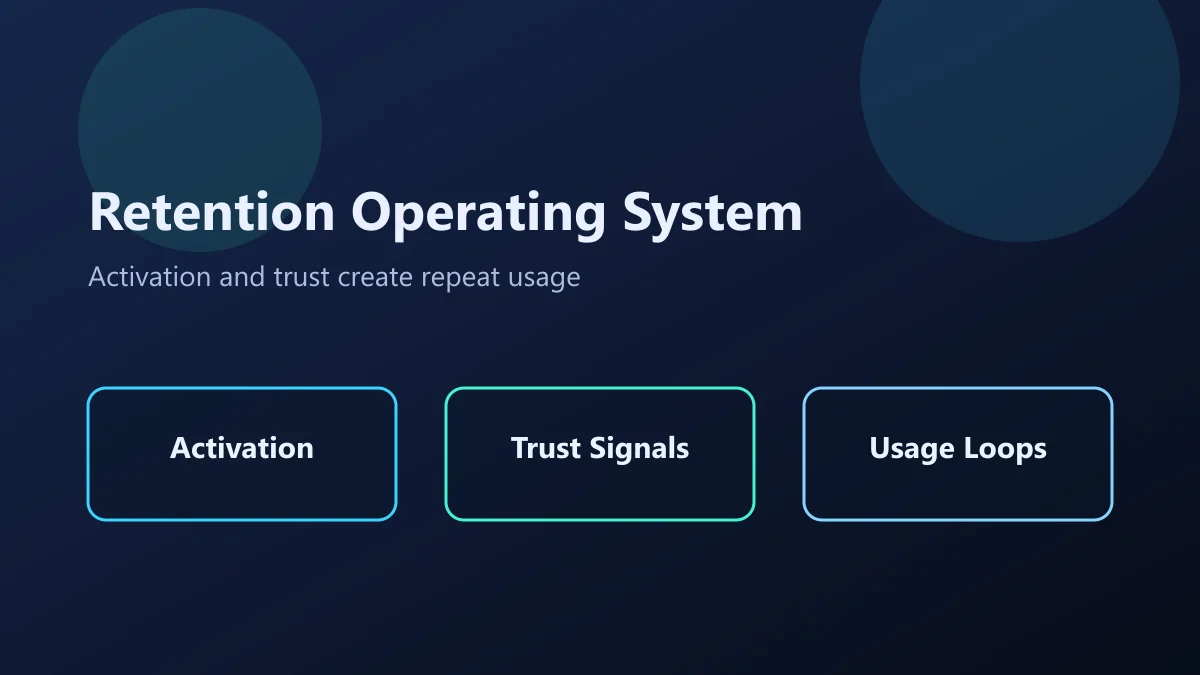
- Activation and trust are the foundation of retention.
- Design recurring workflow loops, not one-time experiences.
- Ship one retention improvement every week.
1. Define Activation Around User Outcomes
Activation should represent first meaningful value, not just account creation. Example: user completes one workflow and accepts output with minimal edits.
- Set one activation event per primary use case
- Track time-to-activation and drop-off steps
- Reduce onboarding branches that delay first value
2. Add Trust Signals Where Decisions Happen
Trust gaps are a top cause of silent churn. Users need to see and control output quality.
- Show assumptions and source context when relevant
- Make output editable with low friction
- Provide fallback paths for uncertain or failed generations
- Surface history so teams can review past decisions
3. Build Weekly Usage Loops
Retention grows when your product naturally returns users to recurring high-value tasks.
- Saved templates for repeated workflows
- Team approvals and collaboration checkpoints
- Progress history showing cumulative value over time
- Role-specific reminders tied to work cadence
Retention Operating Model
Use a weekly loop that combines product and communication improvements:
- Review churn reasons, correction patterns, and reactivation misses.
- Prioritize one product fix and one lifecycle message update.
- Ship, measure impact, and repeat next week.
Consistency is more important than large redesigns.
4. Improve Lifecycle Messaging for Reactivation
Good reactivation messages are contextual and useful, not generic reminders.
- Reference one unfinished workflow
- Offer one practical next action
- Reinforce one expected outcome
Messages tied to user goals outperform product announcement emails.
5. Use a Weekly Retention Scorecard
Track metrics that reveal workflow health:
- Activation rate and median time-to-value
- Weekly return usage for activated users
- Output correction rate by segment
- Reactivation conversion rate
- Churn reason categories by cohort
6. Run Structured Retention Experiments
Keep experiments small and measurable.
- Product experiments: trust UI, workflow simplification, saved templates
- Messaging experiments: reminder timing, copy framing, CTA clarity
- Commercial experiments: plan packaging tied to recurring value
Review results weekly and keep only experiments that improve return usage and quality.
Final takeaway
Retention is not a single feature. It is a system of activation clarity, trust controls, and recurring workflow value. Build this system weekly and churn drops naturally.
For full growth alignment, combine this with the distribution playbook and pilot-to-paid conversion guide.
Frequently Asked Questions
What retention metric should AI startups track first?
Weekly return usage for activated users is a strong starting metric because it reflects habit formation and product value.
Why do AI products lose users after onboarding?
Users churn when outputs are hard to trust, workflows feel inconsistent, or value is not obvious in daily tasks.
How often should retention experiments run?
Early teams should run at least one product and one messaging retention experiment each week.